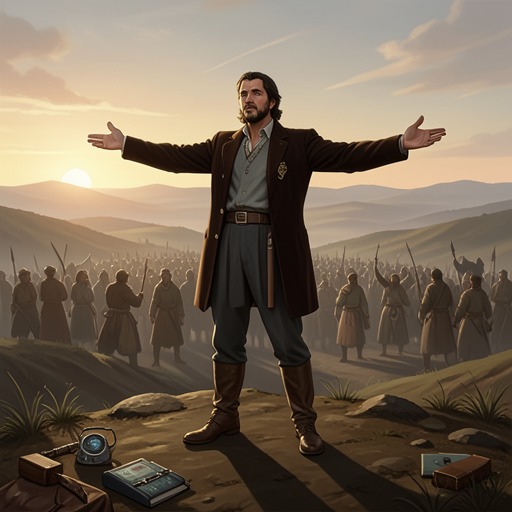
Give back the earth to those who ennoble it with courage and warm it with love
Promise at DawnGive back the earth to those who ennoble it with courage and warm it with love is the ethical ideal Romain Gary places at the center of his childhood story and later life. The expression turns his mother’s promises of future greatness into a responsibility toward other people: the point is not simply to become important, but to help make a damaged world worthy of those who act bravely and lovingly. Its force comes from the tension between that generous hope and a world repeatedly marked by fear, exclusion, and violence.
A childhood ideal
The expression appears as the culmination of a moral world his mother builds for him. Gary describes her as having taught him to recognize hostile powers that prey on the vulnerable; she would press his cheek to hers and identify these forces when times were hard. The imagined enemies became more vivid to the child than familiar objects in his nursery. He recalls growing up wanting to pierce the darkness and absurdity concealing the universe’s true face, and to help his fellow human beings wrest the world from those enemies. The expression gives that childhood struggle its positive end: the earth should belong not to the forces of submission and cruelty, but to people whose courage and love improve it.
Gary states the ideal as a conviction he had carried since childhood: “I grew up in the certitude that one day I should help give back the earth to those who ennoble it with their courage and warm it with their love.” The sentence joins action to care. Courage matters because it ennobles; love matters because it warms. The world is not imagined as already just or kindly, but as something that must be reclaimed and made habitable through human conduct.
The mother’s stories and the promise of France
His mother’s idealism also shapes how he first imagines France. She tells him legends of the country in the Lithuanian forest, where snow silences the world and France is reflected in her face and smile. The child encounters the country through stories, literary fables, Joan of Arc, lead soldiers, and play at taking the Bastille and giving liberty to the world. He learns French through La Fontaine’s fables and comes to feel that French is his mother tongue. In this intimate education, national belonging is not an abstract doctrine: it is bound to his mother’s voice, affection, and vision of a country associated with liberty and goodness.
That ideal also finds an audience beyond the family. After his mother publicly predicts that her son will become a great man, their neighbor Mr. Piekielny takes the prophecy seriously. He treats the boy with new respect, gives him lead soldiers and a cardboard Foreign Legion fort, and later offers him pastry and Turkish delight. The scene shows how the mother’s confident hopes can move another lonely person; the boy’s anticipated importance becomes, for Mr. Piekielny, a source of wonder and personal investment. The larger expression gives that promise a different measure: future distinction matters insofar as it can serve people and answer their hopes.
From imagined belonging to political choice
The fairy-tale image of France eventually collides with the country’s contradictory reality, but Gary says it is too late for him simply to discard the ideal. After the defeat of France, he hears Charles de Gaulle’s appeal on June 18, 1940. The voice recalls for him the old woman who sold hats and had taught him to love France; he rallies without hesitation to the general’s call. The scene joins private memory to public decision: his response to France is inseparable from the maternal stories through which the country first became meaningful.
His early certainty had protected him from anxiety as well as sustained his loyalty. He recalls believing in the French Army and its revered leaders, while his mother’s patriotic assurances formed a kind of inner defensive line. At school in Nice, he learned for the first time that France had been defeated by Germany in 1870; his mother had simply never mentioned it. The omission reveals the fragility of an ideal formed through selective stories. Yet the expression’s moral demand is not blind national worship. It concerns the people who ennoble the world, not the unquestioned virtue of a flag or state.
That distinction becomes personal when he learns why he has been failed at flight school. He is told that he was born in Russia, that his naturalization is too recent, and that a rule for becoming a flying officer requires French parents or more than ten years as a naturalized citizen. Though the rule had been criticized as discriminatory, it is being applied again. The exclusion wounds his sense of belonging, but Gary describes its unexpected consequence as a feeling of becoming truly French: the injury reveals that French people, like others, can be foolish and unjust. He recognizes France as a country made up of many kinds of people and decides that he must choose among them, judge those who hold its flag, and refuse to be blinded by the symbol alone. The ideal of giving the earth back to the courageous and loving thus coexists with a more demanding, critical form of attachment.
Care, violence, and the expression’s reach
Gary’s account does not present the expression as a simple celebration of warfare. He recalls that he had difficulty understanding Hitler and the Nazis, and that his upbringing in a woman’s love had left him incapable of hating anyone for long. He regarded death as regrettable and killing as contrary to his nature, even though he later killed in obedience to the conventions of war. He describes doing so without enthusiasm or satisfaction. Read beside the expression, this recollection makes the difference between courage and hatred decisive: fighting may be necessary, but the ideal does not make killing itself glorious.
The memoir also places this public ethic beside acts of intimate care. As a boy, Gary becomes involved in the lonely painter Josef Zaremba’s hope of finding someone who would care for him. Zaremba says he would be content to take second place in a woman’s affections; Gary prudently raises the question of whether a painter could support a family. Before he is eighteen, Gary begins to see the older man as a father and accepts gifts—including a crocodile-skin wallet containing fifteen American dollars, a camera, and a wristwatch—partly as a way of judging his character and encouraging him in the role. The episode is not a direct statement of the expression, but it gives its concern with human attachment a concrete, complicated setting: affection, need, material help, and obligation are entangled rather than idealized.
At the other end of the memoir’s arc, his mother tells him she has arranged for the best insulin to be sent from Switzerland. Mary Boyd, who had promised to carry it, continues to get insulin to the Hôtel-Pension Mermonts for several years, until a year after the war. This practical chain of care echoes the emotional foundation from which the childhood ideal arose. The expression is therefore both a promise about the world and a standard by which to judge it: courage without care risks becoming another form of violence, while love, made tangible through help and loyalty, gives the struggle its human purpose.